
CURATORIAL PROPOSALS FOR INSTITUTIONS
Museum
Projects
These proposals are developed in close consultation with curatorial teams and adapted to the specific context, history, and programme of each institution.
01 CURATORIAL POSITION Generative art is not only an image. It is a system, a process, and a form of authorship.
My museum projects explore what happens when the underlying system becomes part of the artwork itself. Instead of treating generative works as static digital images, the projects investigate systems that evolve, respond, translate across media, or involve their audience.
02 INSTITUTIONAL PROJECTS
01
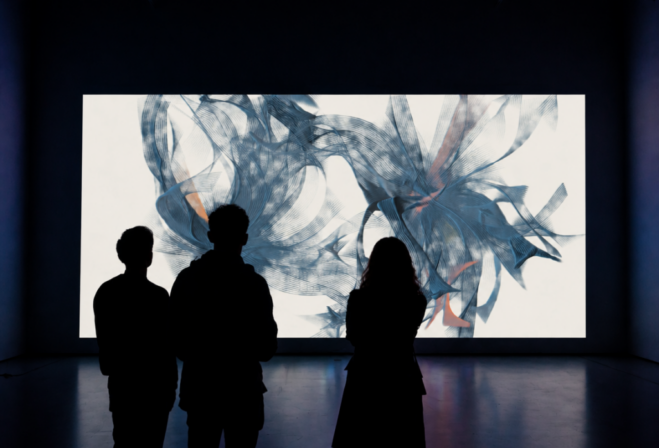
A collection of generative works that continues to evolve beyond the moment of acquisition. Visitors encounter a different exhibition each time. Not because the works have been exchanged, but because the system itself is alive.
„Can a museum collect a behaviour? What does it mean to acquire a system rather than a singular object?“
Installation / Generative Systems / Process
02
Visitors influence the emergence of works. Their presence, movement, or choices become inputs to the generative system — they do not merely observe but participate in the construction of the image. The boundary between audience and author dissolves.
„What happens to the concept of the audience when visitors become part of the system that produces the work?“
Participation/ Interactive / Co-Authorship / Community
03
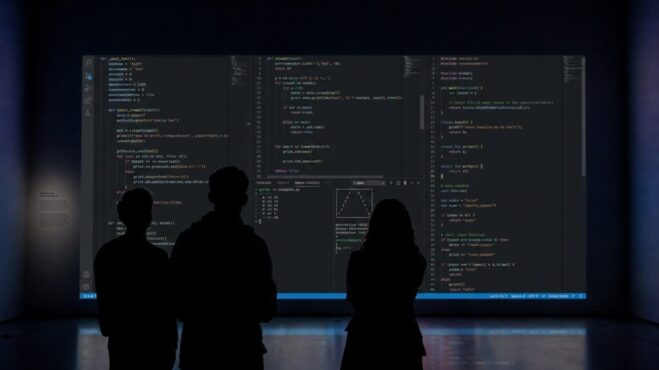
The process of generation becomes visible. The algorithm is the artwork — individual images are only momentary states of an ongoing computation. The institution exhibits not a product, but a logic.
„Where does authorship reside when the image is the result of a collaboration between human intention and machine logic?“
Authorship/ Algorithm / Transparency
04
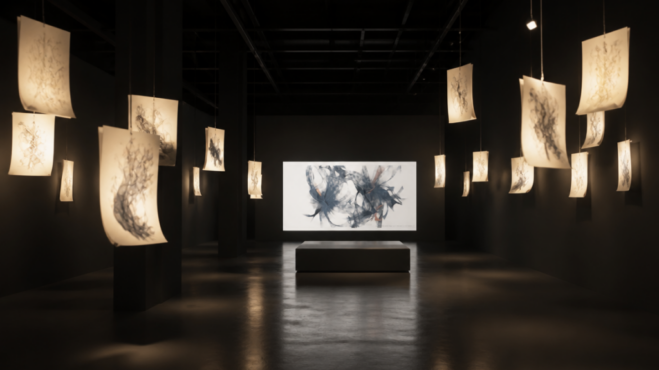
Digital originals enter physical space as large-format prints, light objects, or architectural installations. The exhibition explores the translation between medium; what survives the move from screen to surface, what is inevitably lost.
„How does a digital original manifest in physical space — and what is gained or lost in that transition?“
Digital – Physical / Installation / Medium / Scale
In the Age of AI. Are we degenerating from creators into noise?
Ink on Canvas — Hybrid Spatial Installation
Ink on Canvas connects the analogue language of ink with the contemporary logic of code and generative systems.
Beginning with a single ink drawing on canvas, the work unfolds into a suspended installation of paper and projected light. The projections respond to the sounds of the surrounding space: in quiet moments, delicate organic lines emerge; as the environment becomes louder, they become increasingly harsh, technical and algorithmic.
Human presence thus becomes part of the system. The visitor is no longer only an observer, but an active force that continuously influences and disrupts the work. Ink on Canvas reflects on the shifting relationship between human creativity and technology — and asks whether, in the age of AI, we are moving from creators to sources of interference.
Are we becoming interference rather than creators?
Context
The history, architecture, collection, and programme of the institution form the starting point.
System
A generative system is developed around the conceptual and spatial requirements of the project.
Experience
The final work is considered as an experience within the institution rather than as an isolated digital object.
Translation
Digital systems can become images, physical objects, installations, or responsive environments.
Projects are developed in dialogue with curatorial teams and adapted to the individual institution.
The scope can range from a single generative work to a larger exhibition,